Meta Ads
How to Build a Meta Ads Creative Testing System That Finds Winners
Stop calling five versions of the same ad a test. This practical system shows how to turn customer problems into distinct concepts, test them cleanly, and decide what to cut, iterate, or scale.

PPC & Creative Strategist
Most Meta Ads accounts do not have a testing system. They have a folder of creative, a campaign called “Testing,” and a habit of launching new ads whenever performance gets uncomfortable.
That creates activity, not learning.
A useful creative-testing system answers four questions:
1. What customer belief are we testing?
2. What changed between this ad and the others?
3. What evidence would make us iterate or stop?
4. How does a winning insight become the next batch?
Here is a system you can run every month without turning the account into chaos.
TL;DR
Step 1: Establish the commercial target
Do not start with CPM, CTR, or a target ROAS copied from another brand.
Calculate:
If a product sells for $70 but only contributes $25 after product cost, shipping, payment fees, and discounts, a $32 purchase is not a winner regardless of what Ads Manager calls it.
Your testing system needs a commercial finish line.
Step 2: Build a customer evidence bank
The best concepts usually come from outside Ads Manager.
Collect:
Organize the evidence into four columns:
| Customer evidence | Example |
|---|---|
| Problem | “I have tried three products and nothing lasts.” |
| Desired outcome | “I want something simple I can use every day.” |
| Objection | “It looks expensive for the size.” |
| Proof needed | “Show me it works for someone like me.” |
This becomes the raw material for concepts.
Step 3: Turn evidence into distinct concepts
A concept is the central reason the ad might persuade someone.
These are different concepts:
Changing the first sentence while keeping the same footage, argument, and proof is a variation—not a new concept.
Build three to five genuinely different concepts per testing cycle.
Step 4: Create variations inside each concept
Once the concept is defined, create controlled variations:
Use a simple naming structure:
CONCEPT | ANGLE | FORMAT | HOOK | VERSION
Example:
DEMO | TIME-SAVED | UGC-VIDEO | MORNING-ROUTINE | V1
Clear naming makes the report useful months later.
Step 5: Keep the test environment clean
When testing creative, avoid changing targeting, offer, landing page, attribution settings, and budget at the same time.
The goal is not laboratory perfection—Meta delivery will never be perfectly even. The goal is to reduce enough noise that the result creates a decision.
A practical setup:
1. Use one testing campaign or a controlled testing lane inside the main campaign.
2. Keep the audience broad enough to avoid a tiny sample.
3. Use the same optimization event as the scaling environment.
4. Give concepts enough budget to produce meaningful delivery.
5. Do not launch twelve ads on a budget that can properly test three.
Fragmentation is the enemy. Five ad sets fighting for ten weekly purchases will not teach you much.
Step 6: Read the creative funnel
Do not declare winners from CTR alone. Read performance in layers.
Layer 1: Did it stop attention?
For video, review the opening seconds, hold rate, and how quickly people leave. For static ads, compare impressions, outbound clicks, and negative feedback.
Weak attention usually means the hook or visual frame failed.
Layer 2: Did it create intent?
Review outbound CTR, landing-page views, and the quality of comments or messages.
High attention with weak intent often means the ad entertained but did not make the offer relevant.
Layer 3: Did the page continue the promise?
Compare landing-page views with purchases or qualified leads. If several ads create strong intent and all collapse after the click, the page or offer may be the constraint.
Layer 4: Did it create profitable customers?
The final judgment is acquisition cost, margin, lead quality, and customer value—not the prettiest engagement metric.
Step 7: Use a decision matrix
| Result | Decision |
|---|---|
| Weak attention, weak conversion | Cut |
| Strong attention, weak click intent | Rewrite the argument or CTA |
| Strong click intent, weak conversion | Inspect offer and landing page |
| Efficient conversions at low spend | Validate with more delivery |
| Efficient conversions at meaningful spend | Scale and create iterations |
Do not keep a weak ad alive because “Meta has not spent enough” when every layer is poor. Do not kill a strong concept because one execution had a weak hook.
Step 8: Scale the insight, not only the ad
A winning ad eventually fatigues. A winning insight can produce a family of ads.
If a comparison concept wins, create:
The purpose of testing is to discover what customers respond to, then compound it.
Step 9: Run a weekly creative review
Your weekly meeting should answer:
End with the next creative brief, not merely a dashboard screenshot.
A simple four-week cadence
Week 1: Research and concepts
Review customer evidence and write three to five concept briefs.
Week 2: Production and launch
Produce controlled variations and launch only what the budget can test.
Week 3: Decisions
Cut clear failures, inspect page-level friction, and give promising concepts enough delivery.
Week 4: Iteration
Turn winning insights into new hooks, formats, and proof.
Then repeat.
How many new creatives should you launch each week?
There is no responsible universal quota.
Production volume should follow:
An account spending $50 per day should not imitate the content volume of an account spending $5,000 per day. Launching more ads than the budget can evaluate creates a backlog of under-delivered ideas, not a stronger testing program.
Use a coverage target instead of an arbitrary weekly count. Maintain:
1. One or more proven concepts carrying efficient spend.
2. A small set of controlled challengers based on customer evidence.
3. A production queue ready before a winner materially weakens.
4. Clear labels so results accumulate into reusable insight.
If performance changes, use the seven-day Meta ad-fatigue diagnosis to separate concept fatigue from auction volatility, landing-page issues, tracking changes, or sales-process problems.
The mistake that makes every test unreliable
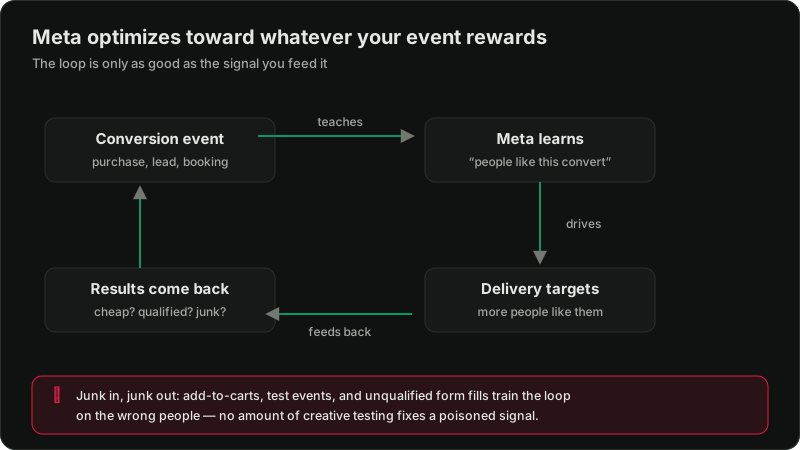
If purchase or lead tracking is duplicated, missing, or unable to distinguish quality, creative decisions will be built on false outcomes.
Before scaling the system, run the 21-point Meta Ads audit and verify Pixel and Conversions API tracking.
Creative testing is not a content calendar. It is a commercial learning system.

Written by
Vince Servidad
PPC & Creative Strategist
I find why paid traffic is not turning into customers, then fix it. Google Ads, Meta Ads, creative strategy, landing pages, Shopify development, conversion tracking.
Apply it to your account
Need help applying it?
Share your website, goal and current setup. We can discuss whether the project is a fit and agree on the scope before work starts.
Get a project review ↗